



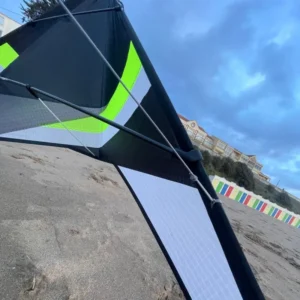


Optimist (by Richard Debray)
$420.00
Arriving late October 2026!
Designed by multiple French, European and World Champion Richard Debray, the Optimist is a full-size dual-line sport kite built around an unusually broad performance envelope.
Description
Designed by Richard Debray
.
Richard Debray has spent more than two decades at the highest levels of dual-line sport-kite flying and design, earning eight French individual championships and at least seven European individual titles while developing and refining some of the most historically popular kites for competition, freestyle, training and demonstration.
That experience is reflected in the Optimist’s design philosophy: performance does not have to come at the expense of accessibility, delivering a kite that is rewarding during everyday training while retaining the precision, adjustability and freestyle capability expected from a serious competition-level sport kite.
The Optimist combines moderate speed and low pull with stable tracking, crisp changes of direction and a remarkably complete freestyle vocabulary. It was designed not as a specialist trick kite or pure precision machine, but as a versatile training and performance platform that can move comfortably between precision, freestyle, team flying and competition.
That balance is the heart of the Optimist.
Its moderate pace gives the pilot time to work, while its stability makes straight lines and deliberate direction changes predictable. Stops, two-point landings, spikes and combinations are deliberately accessible, while the kite remains capable of an extensive modern freestyle repertoire including Axels, Half Axels, Cascades, Comètes, Slots, Multislots, Taz Machines, Fades, Turtles, Backspins, Rolling Cascades, Multilazys, Insanes and Cyniques.
TEAM CAPABLE
Specifications
- Skill level: Intermediate through Expert
- Wingspan: 88.6” / 225 cm
- Height: 39.4″ / 100 cm
- Wind range: 4-15 mph / 7–25 kph
- Sail: 37 g Icarex polyester with Mylar reinforcement
- Frame:
– Spine: 6 mm carbon (88 cm)
– Upper spreader: 5 mm carbon (56 cm)
– Upper leading edge: Dynamic DT12 (73.5 cm)
– Lower leading edge: Mystic 14 (73.5 cm)
– Lower spreaders: Mystic 14 (70 cm) - Bridle: Adjustable three-point
Built for performance
The Optimist uses an adjustable three-point bridle that allows the pilot to tune more than simply the kite’s angle of attack.
Small changes to the bridle geometry affect incidence, turning response, pull and the amount of structural damping in flight. Richard notes that an adjustment of only 5 mm from neutral produces a noticeable change in the kite’s behavior.
The neutral position provides the most versatile general setting. For team flying, Richard recommends a lighter setting together with lines of at least 40 meters to reduce speed and responsiveness and produce smoother, more manageable formation flight.
The result is a kite that can be tuned around the conditions, line length and pilot rather than forcing the pilot to adapt to one fixed personality.
Additional information
| Weight | N/A |
|---|---|
| Dimensions | 35 × 3 × 3 in |
Reviews (0)
Related products
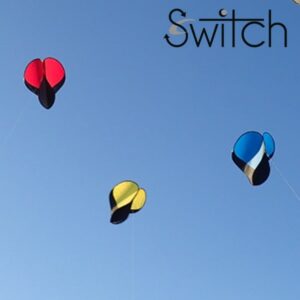
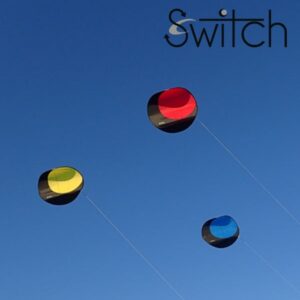
Arriving late October 2026! A single-line kite that refuses to behave like one. Alain Micquiaux's Switch flies stably when left alone, but sharp line inputs activate its unique sliding bridle, allowing directional changes, reverses, rotations and freestyle tricks—all from a single flying line. They also make a beautiful sky display when set up in multiples.
This product has multiple variants. The options may be chosen on the product page

The Kaiju is tailored to extremely light wind or indoor kite flying on short lines.
This product has multiple variants. The options may be chosen on the product page

Designed by Lam Hoac & Josh Mitcheson
Built for raw freestyle performance, The Object is a high-aspect beast designed to hit hard, rotate fast, and break boundaries. With a 2.3 metre wingspan and a geometry honed for four-axis rotation, this kite thrives on forecasted inputs, dynamic feedback, and technical flow.
This product has multiple variants. The options may be chosen on the product page

Designed by John Barresi and Brett Marchel for entry level quad kite fliers or those on a budget, the Djuice has been thoughtfully crafted from over 20 years of face-to-face instruction with pilots at all skill levels from all over the world, this kite is all about the learning process and is backed up with unparalleled support. Comes complete with 5 Dynamic rods, 2 ferrules and a storage sleeve with pocket for storing your lines, handles and stake. Just add a choice of lines and handles, and you're ready to fly!
This product has multiple variants. The options may be chosen on the product page

Designed by John Barresi and Brett Marchel, the Djinn is a high performance quad line kite built for a variety of applications and wind conditions with multiple features to increase overall control, sail loading, durability and ease of use. Read the full description below for more in-depth information and critical details you should know before ordering. NOTE: Colors / models shown as "out of stock" typically ship within 4-8 weeks, custom colors may be longer. All kites signed by JB unless specified otherwise - ask about full suite discounts!
This product has multiple variants. The options may be chosen on the product page
Reviews
There are no reviews yet